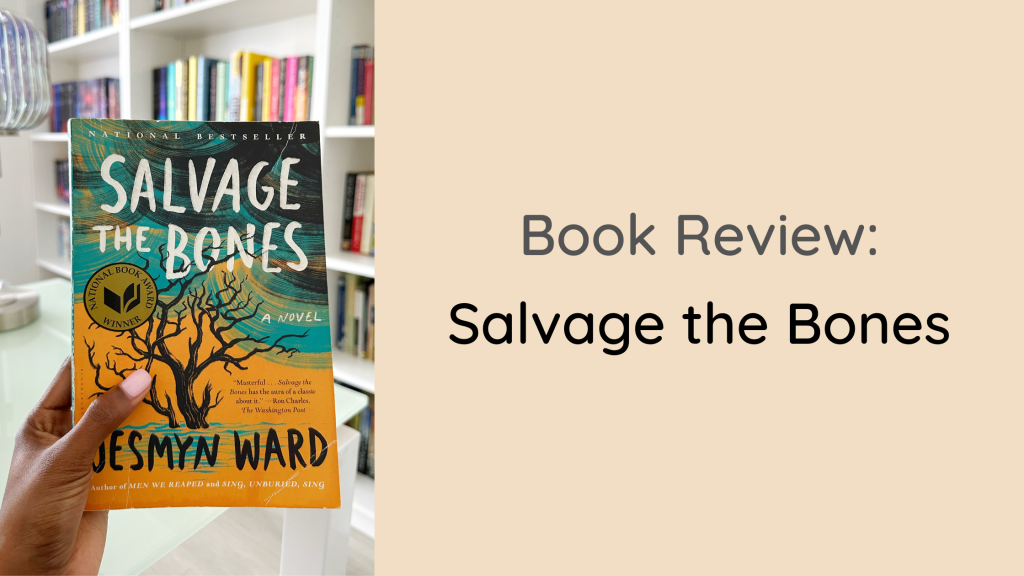
“I’m still trying to find the words.” Those were my initial thoughts after finishing Jesmyn Ward’s Salvage the Bones, my first novel by the author. I went into Salvage with a critical eye as the book was highly lauded, and it was also set to chronicle an experience I knew all too well. By the time I turned the final page of the book, I was left changed by what I had read.
About the Book
A hurricane is building over the Gulf of Mexico, threatening the coastal town of Bois Sauvage, Mississippi, and Esch’s father is growing concerned. A hard drinker, largely absent, he doesn’t show concern for much else. Esch and her three brothers are stocking food, but there isn’t much to save. Lately, Esch can’t keep down what food she gets; she’s fourteen and pregnant. Her brother Skeetah is sneaking scraps for his prized pitbull’s new litter, dying one by one in the dirt. While brothers Randall and Junior try to stake their claim in a family long on child’s play and short on parenting. As the twelve days that comprise the novel’s framework yield to the final day and Hurricane Katrina, the unforgettable family at the novel’s heart–motherless children sacrificing for each other as they can, protecting and nurturing where love is scarce–pulls itself up to struggle for another day. A wrenching look at the lonesome, brutal, and restrictive realities of rural poverty, Salvage the Bone is muscled with poetry, revelatory, and real (via Goodreads).
Sensitive topics include: teen pregnancy, alcoholism, and dog fighting.
Review
When I first began reading Salvage the Bones, I was both curious and hesitant. Awarded the National Book Award in 2011, Salvage the Bones is a highly regarded novel in a variety of literary spaces. It is also one that details an experience I share with Ward and the characters of the book as a fellow Gulf Coaster also affected by the storm represented in the novel, 2005’s Hurricane Katrina. I couldn’t help but wonder what this portrayal of the storm would look like, and how it would feel to read as someone not from the outside looking in, but with memories of my own to compare. My hesitancy, then, as you can imagine, stemmed from a place of self-protection.
Ward seemed prepared for such a response, and redirects reader expectation by focusing on the quotidian, every-day of life of protagonist Esch as the single girl among brothers and a widowed father. This approach reconstitutes the significance of the storm by first showcasing the value and complexity of the lives that were lived before its arrival in the fictional town of Bois Savauge, Mississippi for Esch and her family. Ward’s intentional detail is similarly applied when describing the life of the pitbull China, and her relationship to her owner and Esch’s brother, Skeetah. As I read further into the novel, I felt my hesitancy slowly fade as I began to trust Ward’s hand as a new reader. Ward finds the beauty in these relationships, even among the grit and dire circumstances. The novel seethes realism, and though its rawness is sometimes difficult to read, I liked that Ward was committed to such an honest approach.
I also deeply appreciated Ward’s meandering writing style and how it to painted a holistic portrait of an impoverished community with depth. Each use of figurative language is spliced with a memory of Esch’s community and her family that allows the reader to see and experience the world as Esch does. Though I initially found this style difficult to parse through, I was grateful for all that it revealed about Esch’s late mother and her life beyond the book’s central narrative.
When the day of the hurricane finally arrived for the characters in the novel, I was genuinely holding my breath. Ward’s realism, attention to detail, and effortless writing style were all counting down to this moment, and she ultimately remains unrelenting in her representation of Katrina’s destruction. Ward strikes an impressive balance here: her words are poetic, though the representation of the storm is anything but figurative. Ward’s words were visceral and chilling, and most importantly, they were necessary. The final chapter of the novel, titled “Alive,” is both relieving and unnerving—emotions often born out of experiences of survival.
Conclusion
Jesmyn Ward’s Salvage the Bones is story about survival amidst poverty and environmental disaster, and the harrowing effects when the two overlap for Esch’s family during Hurricane Katrina. I found this book to be simultaneously challenging and compulsively readable—which speaks to Ward’s success as an author. I can’t wait to read more from Jesmyn Ward in the future!
My Ratings
Grading Scale

Star Scale

Until next time,



 City of Deja
Leave a reply to A Belated Quarterly Reading Wrap Up Vol. 2 – City of Deja Cancel reply