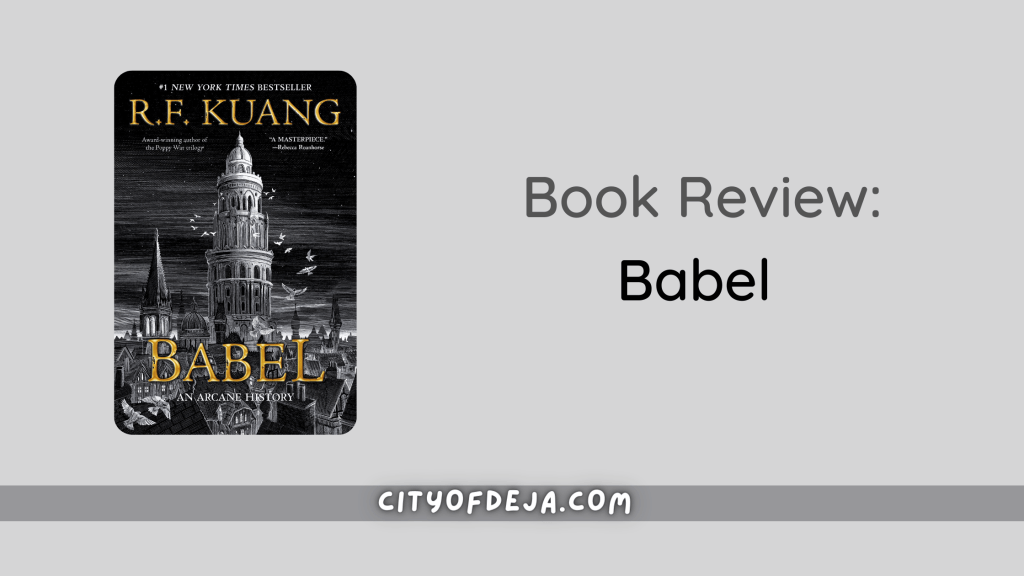
R.F. Kuang’s Babel: An Arcane History was a pretty good read—if a little imbalanced.
About the Book
Traduttore, traditore: An act of translation is always an act of betrayal.
1828. Robin Swift, orphaned by cholera in Canton, is brought to London by the mysterious Professor Lovell. There, he trains for years in Latin, Ancient Greek, and Chinese, all in preparation for the day he’ll enroll in Oxford University’s prestigious Royal Institute of Translation—also known as Babel. The tower and its students are the world’s center for translation and, more importantly, magic. Silver-working—the art of manifesting the meaning lost in translation using enchanted silver bars—has made the British unparalleled in power, as the arcane craft serves the Empire’s quest for colonization.
For Robin, Oxford is a utopia dedicated to the pursuit of knowledge. But knowledge obeys power, and as a Chinese boy raised in Britain, Robin realizes serving Babel means betraying his motherland. As his studies progress, Robin finds himself caught between Babel and the shadowy Hermes Society, an organization dedicated to stopping imperial expansion. When Britain pursues an unjust war with China over silver and opium, Robin must decide . . .
Can powerful institutions be changed from within, or does revolution always require violence? (via Goodreads).
Review
My thoughts on R.F. Kuang’s Babel: An Arcane History are pretty short and sweet. Unlike my reading experience with Yellowface, Babel didn’t leave me with much to ponder once I’d finished it.
As a project, Babel accomplished its goal of disrupting the dark academia sub-genre by exploring the dangers of a complacent academy under colonialism. The book presented the reader with an interesting and compelling concept, as expected from R.F. Kuang.
That being said, as a novel, Babel’s weakest points were in its plotting and pacing. I was hooked during the first half, but the last 40% really dragged for me. Kuang’s writing became a bit long winded, and definitely focused more on telling rather than showing. I held out hope that once the climax kicked in, the pace would pick back up. However, the final stretch of the book was bogged down with over-explanation.
I think if being judged as a novel with a well-crafted story, Babel could have endured another round of hyper-critical editing. But I understood and thoroughly enjoyed its themes of anti-colonialism, the power dynamics of the academy, and the process of revolution. The character journeys were also fun to read, which kept me interested enough to finish the book.
Overall, Babel might be one of those books that’s a little better upon a re-read. Though for now my conclusion is this: Babel didn’t blow me away, but it wasn’t all bad either.
My Ratings
Grade scale:

Star scale:



 City of Deja
Leave a reply to Helen Cancel reply