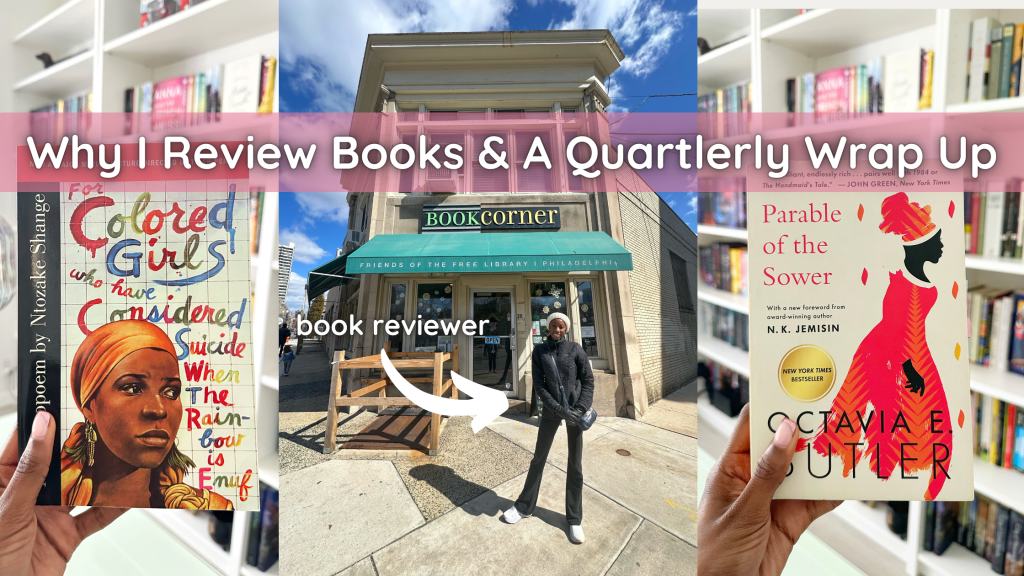
The book review is one of my favorite forms writing. I’ve been writing reviews on this blog for about five years now (and writing/sharing other forms of book reviews and reactions since I began my Bookstagram over ten years ago), and I still love experiencing the satisfaction of publishing a book review. With so many books to choose from—from backlist titles to hot-off-the-press releases—the book review is how I decide what to pick up next. Reviews also help me to refine my taste in literature by articulating what worked me and what did not within a particular text. Considering I have an entire blog where book reviews make up the majority of my blog content, it should come as no surprise that I value the art of writing a review for a book. This sentiment was solidified even further after I read the following quote from literary critic and academic Barbara Christian in her text “The Race for Theory”:
For me, literary criticism is promotion as well as understanding, a response to the writer to whom there is often no response, to folk who need the writing as much as they need anything. I know, from literary history, that writing disappears unless there is a response to it. Because I write about writers who are now writing, I hope to help ensure that their tradition has continuity and survives.
Though Christian is referring to literary criticism of Black women’s writing in this piece and not book reviews specifically, the larger sentiment still applies: “writing disappears unless there is a response to it.” I respond to what I read as a way to archive my thoughts and share them with those who also value the book review or striking up a discussion about a book or literary topic. But Christian’s point makes me even more eager to respond to the books that I love in an effort to keep them in the rotation of an ever-changing literary landscape. I have my qualms with how books are marketed in the contemporary moment, so I think that writing thoughtful reviews is also my way of responding to a book divorced of the marketing tactics and gimmicks and down to what makes a text worth reading.
Though I love book reviews, I also find them challenging to write at times and have experienced that sentiment more often than not in this first quarter of the year. I had grown comfortable in reviewing within my niche genre interests and within the marketing schematics I was given. But as my reading habits begin to expand, so does my reviewing, and my goals for writing those reviews. This post is my first attempt at writing those challenging reviews by wrapping up my reading from the first quarter of 2025.
For Colored Girls Who Have Considered Suicide/When the Rainbow is Enuf by Ntozake Shange
Shange’s For Colored Girls was the first book that I read in 2025, and it truly set the tone for this year. I loved the themes of love and its discontents and the ranges and colors of womanhood that Shange explores in this text. As a choreopoem, the text is also meant to be experienced as a play, and I hope that I have the pleasure of watching it live at some point. I will definitely be returning to For Colored Girls for years to come and I can’t wait to read more from Shange.
Ratings
Star Scale:

Grading Scale:
Slave Moth: A Narrative in Verse by Thylia Moss
As a neo-slave narrative written in verse, Slave Moth was quite a challenging read. As such, it took some time for me to adjust to the writing style and structure against the heavy themes. However, once more acquainted with Moss’s steam of consciousness writing style, I was compelled by the story. I enjoyed the elements of resistance through writing and literacy as displayed by protagonist Varl, and the overall complexity of her character in opposition to her present condition. I’m still reckoning with the ending and what is left unsaid, though I think that is the point of the book. I look forward to re-reading this one in the future.
Ratings
Star Scale:

Grading Scale:

Parable of the Sower by Octavia E. Butler
I’m still grappling with Parable of the Sower even over a month later. This book has made its way into the cultural zeitgeist since we are living in the Parable of the Sower years, as Butler published the text in 1993 but set the book to begin in the year 2024 after the collapse of society as we know it. I read a loved Butler’s Kindred last year, and while I still prefer it to Parable, I do think that there are many lessons imbedded into the fabric of this book that will continue to stick with me. The protagonist, Lauren, a young Black preacher’s daughter, develops a belief system called Earthseed that sustains life in this post-apocalyptic world, and this completely captured me as a reader. I read this book for my thesis research on Black girlhood, but the spiritual aspect of the novel blew me away, so my reasoning for using this novel in my thesis has transformed. Like I said: I am still grappling lol. What I do know for certain is that Butler’s cautionary tale in this book is one that I will continue to return to.
Ratings
Star Scale

Grading Scale

Fangirl: The Manga (vol. 1-vol. 4)
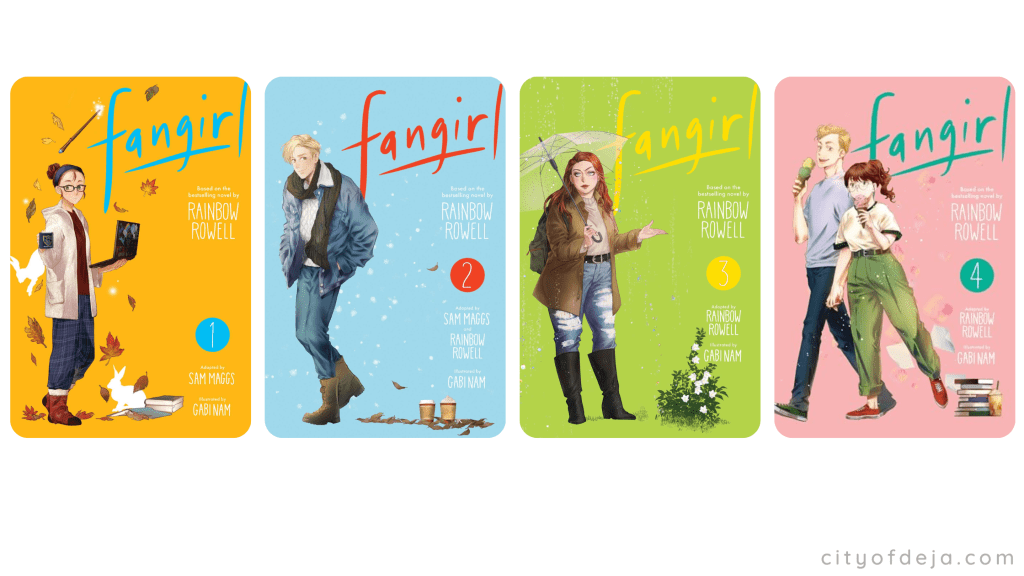
Though I only read the fourth volume in the Fangirl manga adaptation this year, this conclusion means that I can finally offer up my thoughts on the entire collection. I should preface this by saying that manga is not a genre that I typically reach for, and I only read this series for the nostalgia. I loved the YA contemporary novel Fangirl when I first read it, and I thoroughly enjoyed the Simon Snow Trilogy, a spin-off series born out of Fangirl.
However, reading this manga adaptation as it released over the last three years (as opposed to binge-reading when all four volumes were published) was…a choice. Probably the wrong one, if I’m honest. The fourth and final installment felt very abrupt, which was partly unsatisfying in the end. My investment had waned as I read on and I didn’t think much about the series after finishing it. As such, the Fangirl manga series will remain a a one-time read for me.
Ratings (Full Series)
Star Scale
Grading Scale
Thanks for reading.
Until next time,
 City of Deja
Leave a comment